

August 2, Kathmandu.
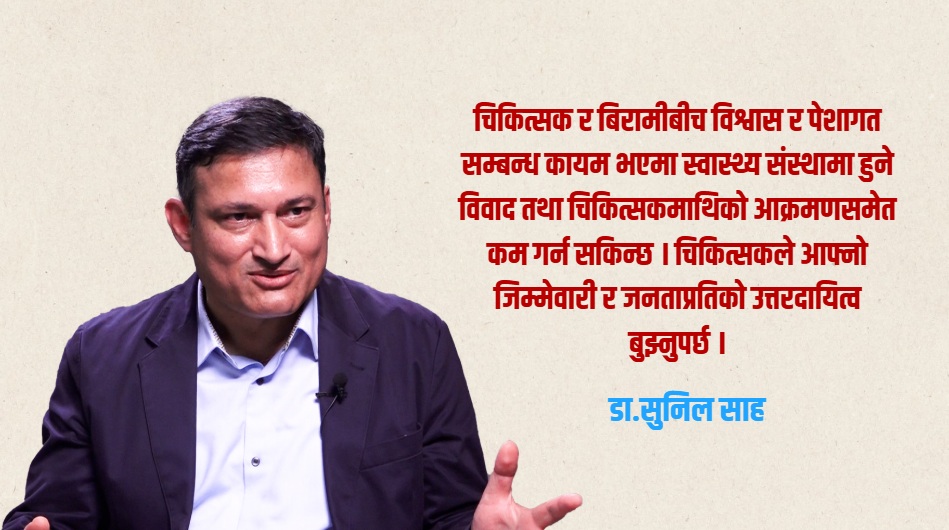
Dr. Sunil Sah, a Nepali doctor working in the UK, stated that although there has been some improvement in Nepal’s health system in the last decade, it has not been able to gain the expected momentum compared to other low and middle-income countries like Nepal.
He stated that significant improvement is still needed in four aspects of Nepal’s health system: infrastructure, equipment, human resources, and systemic coordination.
In an interview with Nepal News Bank, Sah said that although there has been an improvement in Nepal’s health sector after the earthquake, Nepal has not been able to make expected progress in the health sector when compared to countries with similar economic conditions such as Africa and India.
According to him, since health, education, and living standards are considered major criteria for entry into the European Union, improvement in the health system is crucial for the overall development of any country.
He said, ‘Nepal’s health system has seen many improvements post-earthquake. But we need to compare. If we look at the improvements in low-middle income countries like Nepal, such as in Africa, ours hasn’t been that much. Even the improvements seen in India over 10 years are more than ours.’
Improvement needed in four aspects of the health system
According to him, Nepal’s health system needs to be looked at mainly from four aspects. The first is infrastructure and space, the second is the purchase and utilization of equipment, the third is health human resources, and the fourth is the necessary coordination within the health system.
Sah stated that despite investment in infrastructure and equipment for hospitals and health institutions in Nepal, it has not been effectively utilized. He added that even though equipment is purchased at government and regional levels, the lack of necessary human resources to operate them leads to millions in investment going unused.
Sah shared his experience of directly witnessing such a situation during his visits to various hospitals in Madhesh Province. He mentioned observing the condition of hospitals from Rajbiraj to Birgunj, stating that many hospitals have the necessary equipment but lack skilled human resources to operate them.
Equipment exists, but skilled human resources do not
Giving the example of Lahan Hospital, he stated that although the hospital has a CT scan machine, there is a lack of radiographers and radiologists to interpret its reports.
He said, ‘Lahan has a CT scan, but there are neither radiographers nor radiologists to interpret the CT scan reports. If there are no radiographers or radiologists, why send a CT scan? Just sending equipment isn’t enough.’
According to Sah, purchasing equipment alone cannot make healthcare services effective. Necessary human resources, management, and accountability must also be ensured. He noted that when equipment is not used, its condition deteriorates after some time, and even if new equipment arrives, the old ones become unusable.
Sufficient human resource production but a challenge to retain them
Sah stated that despite sufficient production of health human resources in Nepal, they cannot be retained within the country. He mentioned that Nepal is producing a larger number of doctors, nurses, and dentists than required for a population more than double that of the UK, yet these professionals are migrating abroad.
‘We have staff. We produce more doctors than England, more dentists, and more nurses for a population double that of England. But we have not been able to retain the staff,’ he said.
According to Sah, to improve the health system, it is necessary to create an environment for human resources to work within the country, alongside their production. He stated that the lack of opportunities and leadership responsibilities for young doctors and health workers has led to an increase in their migration abroad.
Lack of coordination in the health system
He stated that the lack of coordination in the health system is also a major problem in Nepal. He explained that due to insufficient coordination from the center to primary healthcare services, available resources and human resources are not being properly utilized.
Sah said, ‘The emigration of young doctors and health workers has increased due to the inability to provide them with opportunities and leadership responsibilities. To improve the health system, we must create an environment for them to work within the country alongside producing human resources. We haven’t been able to come forward in the name of the system. We have no coordination whatsoever. There is no coordination from the center to primary care.’
He also expressed expectations that the new government should improve the health sector. Mentioning that the public has given a large majority to the new government, Sah stated that the public has hope in the new government because previous political parties and governments could not perform as expected.
Doctors are servants, not Gods
Meanwhile, Sah also questioned the relationship between doctors and patients and medical professional conduct in Nepal. He commented that doctors in Nepal can be categorized based on various interests and roles, pointing to the existence of celebrity doctors, medical mafias, political doctors, and business-oriented doctors.
He stated that doctors should not present themselves as gods. Mentioning that doctors are public servants, he said that doctors themselves must be responsible for maintaining professional dignity.
He said, ‘Doctors are servants, not gods. In England, doctors are servants. Politicians are servants. People working in the news are service providers. People working in the police are servants.’
According to him, if trust and a professional relationship are maintained between doctors and patients, disputes in health institutions and attacks on doctors can be reduced. He stated that doctors should understand their responsibilities and accountability to the public.
Call for the Medical Association to return to its professional role
Sah stated that professional organizations of doctors should also prioritize professional matters over political activities. He said that organizations like the Medical Association should focus on the real problems of patients, healthcare workers, and the health system.
He said, ‘You must come back to your professionalism, understand the public’s concerns. Understand the patients’ issues; if it’s for money, don’t be a doctor. If you want to earn money, do business.’
Advertisement
Sah also raised questions about the fee and ‘donation’ system in medical education in Nepal. He stated that the need to spend a large amount of money to acquire medical education carries the risk of turning the medical profession into a means of recovering investment rather than a service.
According to him, medical education fees should be transparently and systematically managed as education fees rather than ‘donations.’ He stated that young people who become doctors after spending a large amount on medical education might develop a mindset of seeking returns on their investment.
Sah said, regarding ‘donation’, ‘The situation of having to spend a large amount of money to acquire medical education has increased the risk of turning the medical profession into a means of recovering investment rather than a service. This is not a donation, this is education. It’s not that you have to give this much donation if you do medical studies; it is an education fee.’
He stated that due to large financial investments in medical education, there’s an increased tendency for doctors to become business-oriented after qualifying. He believes the government’s role is necessary to regulate the trend of opening private hospitals and clinics immediately after becoming a doctor.
Young doctors must be brought into leadership
Sah stated that the youth exodus from the health sector is happening because young doctors are not given leadership and opportunities. He mentioned that the influence of the older generation still persists in many important health institutions, and therefore, qualified and skilled young doctors should be brought into leadership.
Giving the example of young generations playing a crucial role in the UK’s National Health Service system, he stated that young doctors in Nepal should also be given responsibilities.
According to him, young doctors have new ideas regarding technology, management, and health system reform. He believes that if they are given opportunities, significant changes can be brought to the health system within two to four years.
Sah also considers the development of a digital system in the health sector important. He presented an example of how a patient’s health details, from birth to death, can be tracked through a single number in the UK’s National Health Service system.
He suggested that Nepal should also develop a system where every citizen is provided with a unique health identification number, allowing their health history to be viewed in any hospital nationwide. He stated that this would reduce the problem of repeated tests for the same patient and help make treatment more effective.
Transparency needed alongside investment in the health sector
According to Sah, transparency is also necessary in the insurance and grant system. He stated that regular monitoring and auditing are required to determine where government grants for the health sector are spent, how many patients received services, and what the outcomes were.
Stating that improving Nepal’s health system will take time, Sah also emphasized the need to understand the limitations of resources. He believes that since Nepal is still a low and middle-income country, investment in the health sector should be increased, and available resources should be utilized effectively.
Essential services should not be affected during doctor’s protests
Regarding doctors’ protests, Sah also compared the practice in the UK with the situation in Nepal. He stated that even if a protest is necessary concerning doctors’ demands, the practice there is to first take members’ votes within the organization, give the government sufficient time, and seek solutions through dialogue.
According to him, protests are managed without completely shutting down essential services. He stated that hospital management arranges for services to run in a way that emergency and essential services are not affected.
However, in Nepal, he states there is a significant imbalance between the doctor-patient ratio and hospital capacity. Giving the example that Madhesh Province has a population of approximately 6 million, but the government has allocated only 500 beds, he said that beds, doctors, and other human resources should be determined based on population and healthcare needs.
Sah also stated that the excessive concentration of health services in Kathmandu is a major problem in Nepal. He explained that as major health institutions like Bir Hospital, Kanti Hospital, and Teaching Hospital are concentrated in Kathmandu, patients from other parts of the country are forced to come to the capital for treatment.
He stated that a review is necessary for the tendency of the private sector and businesses to invest in the health sector only by building hospitals in the capital. He suggested that hospitals and health services should be expanded at the provincial and district levels as needed, through cooperation between the government and the private sector.
Multi-specialty services needed for burn treatment
Sah gave the example of burn treatment services, stating that the situation where all burn patients have to be brought to Kathmandu should end. He said that due to weak road infrastructure and inadequately organized ambulance services in Nepal, bringing patients to Kathmandu takes a lot of time and delays treatment.
According to him, the first 24 hours are extremely crucial for burn patients. Therefore, a structure is needed to provide initial treatment at the district and provincial levels, and specialist services at the regional level.
According to him, not all burn patients need to be brought to the center. Most patients can be treated at the district or provincial level, and a specialized Center of Excellence is only required for complex cases, he stated.
Sah also stated that it is not appropriate to make burn treatment solely the responsibility of a general surgeon. He explained that burn patients require various specialized services, including anesthesiology, cardiology, physicians, urology, nephrology, and intensive care.
Therefore, his suggestion is to expand specialized services by coordinating with government hospitals that have sufficient human resources and infrastructure, rather than establishing separate burn centers with limited resources.
Sah stated that even when the government supports health institutions operating on charity, transparency and accountability must be ensured. He believes that after the government provides funds, regular audits should be conducted to determine how many patients were treated, where the money was spent, and how much the public benefited.
His conclusion is that for the improvement of Nepal’s health system, the government, doctors, the private sector, and citizens must all make their roles service-oriented. He stated that merely increasing the number of health institutions is not enough; effective utilization of existing hospitals, equipment, and human resources, decentralization of services, opportunities for young doctors, digital health records, transparent investment, and strong management are necessary.
According to him, even if not all problems in the health sector can be solved immediately, significant changes can be brought about within a few years if correct priorities are set and investment and human resources are properly managed.
For more: Nepal’s Healthcare Reform Dr. Sunil Sah