
Ishwor Ghimire’s Success in Ramechhap: Self-Sufficiency from Agriculture on His Own Soil, Not Abroad

31 Saun, Ramechhap.
Two decades ago, most young people in the village had one dream—to go abroad, earn money, and improve their family’s standard of living. In the 2060s and 2070s, the trend of young people leaving villages in Ramechhap for foreign lands was intense. The fields in the villages started to become barren, and the courtyards of homes grew silent.
At that time, Ishwor Ghimire of Babiyakhark, Ramechhap Municipality-8, was trying to do something by staying in the village. He had been running a poultry farm. However, he couldn’t earn as much as he expected from poultry farming. After that, he also thought of leaving the village. But the idea of going abroad did not come to him.
‘Leaving the village, but not going abroad’ — deciding this, Ghimire moved to Manthali, the district headquarters, in Poush 2072. He rented some land in Kudahar, Manthali. He didn’t have much capital in hand. He bought two cows and started producing milk. Those same two cows have now become the foundation of his agricultural work.
Initially, milk was produced from the cows. Income started coming from selling milk. After he began using cow dung as fertilizer, he also started vegetable farming. He continued the layer chicken farming for eggs that he had been doing in the village.
His cowshed, which started with two cows, gradually filled up. He didn’t sell the calves born from those cows; instead, he raised them in the cowshed. The number of cows increased, and milk production also increased. ‘Now the cowshed is full with the offspring of just two cows,’ says Ghimire.
Currently, he has 13 cows in his cowshed, including mothers and calves. Among them, 10 are mother cows and three are calves. He has already sold some cows. Currently, five cows are milking, and five are pregnant. Among these, three are preparing to give birth this month.
Advertisement
His cows give 15 to 25 liters of milk daily. He regularly sells the produced milk in the market. ‘The price of milk is not what it used to be, but it’s still good,’ he says.
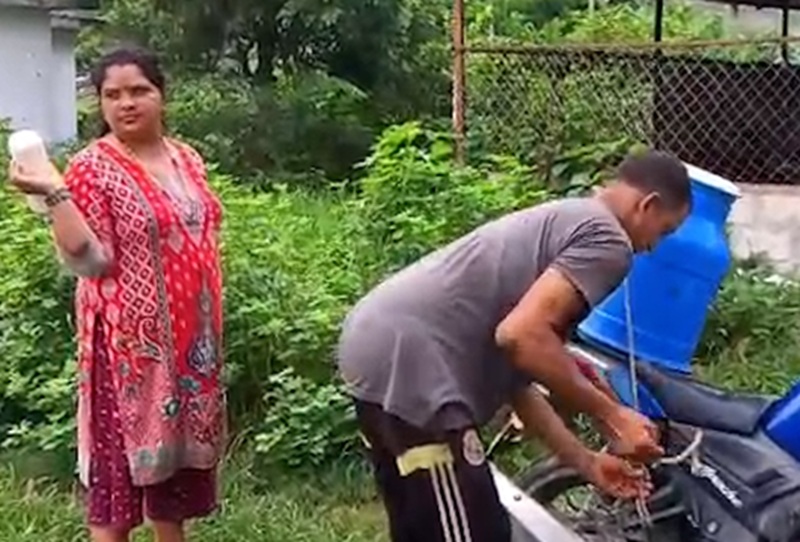
For Ghimire, agriculture is not limited to just rearing cows. Along with cows, vegetable farming and poultry farming have also become part of his daily routine. Early in the morning, he and his wife go to the cowshed, feed the cows grass and fodder, clean the dung, and milk the cows—these tasks are done by the couple together.
After milking, Ishwor carries the milk on his motorcycle and heads towards the market. His wife handles the household chores. The daytime is spent on vegetable farming and caring for the chickens. There is a lot of busyness. There is little time for rest. But he has no complaints about his work.
The Ghimire couple, parents of two sons, are content with their own hard work. For them, agriculture is not just a means of livelihood; it is an example that a respectable income can be earned even by staying in the village. He has demonstrated through his actions the belief that the income one would earn by laboring for hours abroad can be earned by sweating in one’s own village. Along with that, he is also providing pure milk to the market.
The exodus of youth from villages has not stopped yet. Many young people are preparing to go abroad in search of employment and opportunities. But Ishwor’s story is different. He did not choose the path of going abroad. He sought opportunities in his own place. He expanded the work he started with a small investment. He increased the number of cows, increased milk production, planted vegetables, and continued poultry farming. In his cowshed, not only has the number of cows increased, but his self-confidence has also grown.
According to Ishwor, if one is willing to work hard, there’s no need to go far to find opportunities. If you sweat on the soil of your own village, you can create a path to income. His cowshed, fields, and poultry farm are conveying this message—88if you seek opportunities in your own place instead of going abroad in search of work, the land will also provide income.
For more: Ramechhap’s Ishwor Ghimire Turned