


September 15, Kathmandu.
An analysis has been published stating that China, under the leadership of President Xi Jinping, is advancing a strategy to expand its influence in the global order and challenge American dominance.
Analysts have stated that instead of seeking immediate direct confrontation with the US, China is looking to build a new international order in the long term by expanding its economic, diplomatic, and military power. Ryan Hass, a foreign policy analyst at the US-based Brookings Institution, noted in an analysis published in ‘China Leadership Monitor’ that China views the US as a weakening but still dangerous power.
According to him, Beijing is currently pursuing a strategy of expanding its power and influence rather than directly competing with the US for leadership. ‘Even though China believes the power gap with the US is narrowing, it is not presenting it as an immediate victory,’ Hass said. According to him, China has adopted a strategy of long-term competition while avoiding direct conflict between the US and China.
Hass’s analysis suggests that China is trying to change the political and ideological foundations of the current US-led liberal international order. However, he stated that China wants to maintain aspects of the current international system that benefit it. China has long claimed that the influence of Western powers is weakening and its own power is growing. A report published by China’s Ministry of Foreign Affairs in 2021 stated that the US political system was in serious trouble due to ‘money-centered politics, elite rule, political polarization, and a fragile system’.
The China Institutes of Contemporary International Relations, a think tank affiliated with China’s Ministry of State Security, also concluded that the old international order was weakening and a new order had not yet been established.
Recently, China has been demonstrating its influence in areas such as rare minerals, energy, trade, and regional security. China has also been continuously asserting its claims in the South China Sea.
In 2016, the Permanent Court of Arbitration rejected China’s territorial claims in the South China Sea. The tenth anniversary of that ruling fell on July 12, 2026. China, however, has consistently rejected the ruling, calling it politically motivated.
The dispute between China and the Philippines in the South China Sea has also become a major focus of US-China competition. The Philippines has been resisting China’s claims and pressure.
Jay Tarriela, spokesperson for the Philippine Coast Guard, stated that while confronting Chinese ‘disinformation’ is challenging, his country will continue to speak up for its rights and truth.
Meanwhile, Chinese analysts claim that the power gap between China and the US is narrowing. However, it has been analyzed that China has toned down its public rhetoric regarding America’s decline. Hass concluded that this could also be aimed at preventing US President Donald Trump from becoming further agitated.
Interest in Trump-Xi Meeting
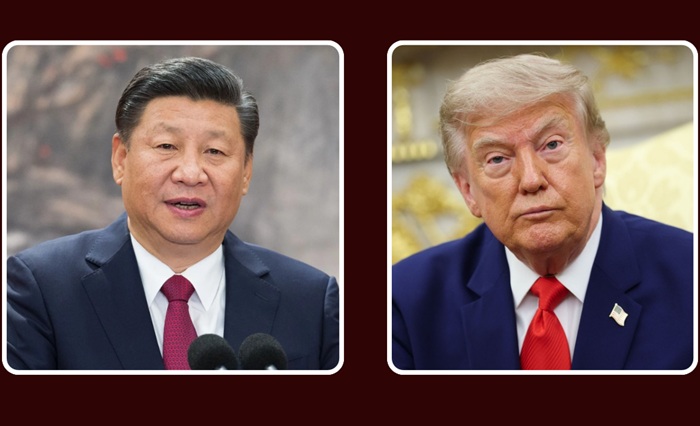
The proposed meeting between US President Donald Trump and Chinese President Xi Jinping in September is seen as significant for US-China relations. Differences between the two countries persist on issues of trade, technology, rare minerals, Taiwan, and global strategic influence.
Analysts say that the changing balance of power has made the competition between the two countries more sensitive. Such a situation, where one power weakens and another rises rapidly, is often linked to the ‘Thucydides Trap’, which increases the risk of conflict.
According to Hass, Beijing also understands the risk of direct conflict between the US and China. Therefore, China views the US as its primary strategic challenge and has adopted a policy of avoiding conflict, engaging in limited cooperation, and preparing for long-term competition. Similarly, former Australian Prime Minister Kevin Rudd has stated that the possibility of China taking military action against Taiwan by 2028 has increased. In an interview on September 13, Rudd estimated that there is about a one-third chance that China will attack Taiwan by 2028. He noted that he has been studying China-US relations for a long time and did not take this conclusion lightly.
Advertisement
According to Rudd, China is rapidly intensifying its preparations for military action against Taiwan. He also described Taiwan’s presidential election in 2028 as a potential ‘tripwire’.
He suspects that if the Democratic Progressive Party, considered anti-China, wins a fourth consecutive term in that election, Beijing could see it as a reason for military action.
2028 will also be the final year of Trump’s second term. According to Rudd, if China draws incorrect conclusions about Trump’s statements on Taiwan and US commitments, it could increase the risk.
However, Rudd stated that if China objectively assesses all risks, it would conclude that military action against Taiwan would be extremely risky. Therefore, he believes that while war in 2028 is not certain, the risk has increased.
‘Rules-Based Order’ Weakening
It has also been analyzed that the US-led ‘rules-based international order’ in international relations is weakening. According to Sir John Chipman, head of the International Institute for Strategic Studies, even during the Cold War, international relations were primarily governed by a balance of power and arms control. Currently, neither an effective balance of power is maintained, nor is there sufficient capacity to enforce international rules.
He stated that international law is not sufficient for current security challenges. He argues that current international law cannot adequately address new types of challenges from non-state actors and ‘grey zones’.
China Needs Resources and Partners for Global Leadership
According to Hass, China has begun to believe that it no longer needs to be bound as strictly by the US-led international political order as it once was. However, his analysis suggests that rather than completely dismantling the old order and building a new one, China is seeking to remove unacceptable aspects and build an order that aligns with its priorities.
Although China has opposed ‘win-win’ cooperation and ‘zero-sum games’, it has been accused of using economic and diplomatic pressure on weaker countries. Critics say that trade, tourism, and investment are also used as tools of political pressure. China’s investment under the Belt and Road Initiative has recently decreased. It has been analyzed that Beijing has started to exercise more caution in selecting projects and countries for investment.
According to Hass, while China’s ambition to change the international order is clear, the question of whether China will succeed in securing the necessary financial resources, investment in international institutions, and support from other major countries to implement it remains open.
According to him, as the US weakens its traditional role of global leadership, an opportunity has been created for China to expand its influence. However, to take that position, China will need to increase not only political rhetoric and ambition but also financial resources, international partnerships, and investment in areas of global public interest.
Thus, while the 2020s show signs of becoming a decade of expanding Chinese influence, analysis suggests that China still faces the challenge of convincing the global community that its objectives are peaceful and acceptable. (ANI)
For More: US China Conflict Risk