

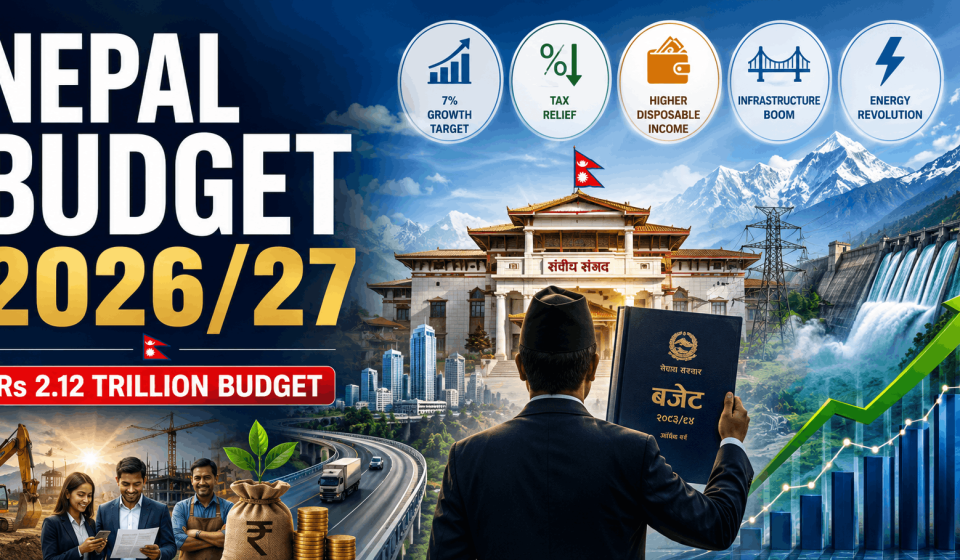

On May 29, 2026, Finance Minister Dr. Swarnim Wagle stood before the joint session of Parliament to deliver what is arguably the most ambitious fiscal roadmap in Nepal’s modern economic history. Presenting a massive, expansionary budget of Rs 2,124.34 billion (Rs 2.12 trillion) for the fiscal year 2026/27 (BS 2083/84), the government has signaled an assertive departure from the conservative, survivalist financial planning of past years. It is a budget built on a grand hypothesis: that the state can trigger a massive private-sector-led economic revival by slashing structural barriers, modernizing tax laws, and investing aggressively in energy and infrastructure.
With an aggressive economic growth target pegged at 7.0% and a mandate to keep consumer inflation capped at 6.0%, this budget is designed to impact every single layer of Nepali society. But budgets are notoriously complex, filled with macroeconomic jargon, shifting tariff structures, and high-flying rhetoric that rarely translates clearly into everyday life. What does a Rs 2.12 trillion expenditure architecture actually mean when you step into a grocery store, receive your monthly salary slip, run a small local business, or attempt to clear goods at a customs border?
In this deep-dive analysis, we break down the hard numbers, strip away the legislative complexity, and analyze exactly how the FY 2026/27 budget alters the economic reality for the common public, the corporate community, and the working class of Nepal.
1. The Macro Picture: Where is the Money Coming From and Where is it Going?
To understand the micro-impact, we must first look at the sheer scale of the balance sheet. The total layout of Rs 2,124.34 billion represents a stunning 25.2% expansion over the revised spending estimates of the current fiscal year. Managing such a massive vault requires an aggressive capital mobilization strategy. Let’s look at how the government intends to split this historic spending and how it plans to fund the deficit.
| Expenditure Classification | Allocation Amount (in NPR) | Percentage Share (%) | Primary Administrative Focus |
|---|---|---|---|
| Recurrent Expenditure | Rs 1,270.58 billion | 59.8% | Civil service salaries, administrative operations, and regular public service delivery. |
| Capital Expenditure | Rs 431.10 billion | 20.3% | Physical infrastructure development, structural engineering, national pride projects, and asset creation. |
| Financial Management | Rs 422.64 billion | 19.9% | Domestic and foreign debt servicing, principal repayments, and state-backed equity investments. |
The immediate structural concern that economists are pointing out is the persistent dominance of recurrent spending, which swallows nearly 60% of the entire budget. However, the government has countered this critique by pointing to its unprecedented revenue collection targets and structural loan management frameworks. The budget is slated to be financed through the following channels:
- Domestic Revenue Generation: The state targets an ambitious Rs 1,405.31 billion purely through internal tax collections and non-tax revenues.
- Foreign Grants: A projected mobilization of Rs 61.74 billion from bilateral and multilateral international partners.
- Foreign Concessional Loans: Net international borrowing is estimated at Rs 247.28 billion to fund long-term development assets.
- Domestic Borrowing: The government will raise Rs 410 billion through internal debt instruments (treasury bills and development bonds).
A Crucial Caveat on Internal Debt: While an internal borrowing target of Rs 410 billion initially raised alarms about liquidity crowding out in the private banking sector, Dr. Wagle clarified an essential nuance in his speech. A massive chunk of existing domestic debt—amounting to Rs 245.89 billion—is maturing within this upcoming fiscal year. Therefore, the net new internal borrowing injected into the economy is effectively capped at Rs 164.11 billion, mitigating fears that banks will run out of investable funds for businesses.
2. For the Common Man and Salaried Professionals: Massive Tax Cuts and Pay Hikes
If you are a salaried individual, a middle-class consumer, or a formal sector employee in Nepal, this budget brings some of the most immediate, positive news seen in over a generation. For years, the middle class has complained about high inflationary pressures compounding flat income growth. The FY 2026/27 budget addresses this directly through a double-edged approach: boosting disposable income and slashing individual direct tax rates.
The Doubling of the Income Tax Exemption Limit
In a historic move to shield low- and middle-income earners from the biting cost of living, the government has doubled the personal income tax exemption threshold to Rs 1,000,000 (10 Lakhs) per annum. Under the previous regime, individuals started paying progressive taxes much earlier. Now, any individual earning up to Rs 10 Lakhs a year will effectively face zero income tax liability (excluding the mandatory 1% social security tax). This instantly injects liquid cash back into the pockets of teachers, entry-to-mid-level corporate employees, bank officers, and healthcare professionals across the nation.
Slashing Top-Tier Marginal Taxes
Furthermore, to curb the severe brain drain of skilled technical professionals, executives, and doctors migrating abroad, the government has restructured the highest tax brackets. The top marginal personal income tax rate has been slashed by 10 percentage points. This aggressive correction ensures that top-tier professionals are incentivized to retain their wealth, invest in local financial markets, and stay within the domestic formal workforce.
A Long-Awaited Pay Elevation for Civil Servants
For the country’s vast bureaucratic machinery, public school teachers, police personnel, and military forces, the budget ends a punishing four-year salary freeze. The government has enacted an overall 21% civil servant salary hike, split strategically into two distinct components:
- A 10% increase in the core base salary scale across all civil service tiers.
- A 11% monthly performance incentive allowance, directly linking the remaining increment to public service quality, accountability, and workplace output.
This pay hike will inject a massive volume of purchasing power into rural and urban consumer markets, driving up retail activity, though economists warn it could place short-term upward pressure on aggregate demand and local commodity prices.
3. For the Business Owner and Local Manufacturer: Protectionism and Deregulation
Dr. Wagle’s budget explicitly states that “the state must stop acting as a competitor to business and instead act as its ultimate launchpad.” For domestic industry leaders, entrepreneurs, and factory owners, the policy adjustments represent a profound paradigm shift designed to stimulate import substitution and local employment.
The Elimination of 360 Excise Duties
In an extraordinary move to deregulate the manufacturing floor, the government has completely abolished excise duties across 360 distinct product categories. Over the years, small businesses were suffocated by bureaucratic compliance over insignificant excise filings on non-luxury, domestically produced goods. By scraping these laws, light manufacturing, agro-processing, and local assembly plants see their compliance costs fall off a cliff overnight.
Customs Tariff Consolidation and the Cascading Principle
Nepal’s notoriously complex 11-tier customs duty structure has officially been compressed into a clean, highly predictable 7-tier customs framework. More importantly, the budget strictly implements the economic principle of cascading tariffs: raw materials required by domestic industries will now strictly attract a tariff rate that is at least one to two tiers lower than imported, fully finished competitive goods. This gives an automatic pricing edge to factories manufacturing paints, plastics, cement, pharmaceuticals, and footwear right here in Nepal.
The 90-Day Single Window Commitment
To fundamentally clean up the bureaucratic corruption and red tape that delays business operations, the budget mandates the launch of an all-inclusive, fully automated online platform within 90 days. This system will integrate company registration, tax compliance management, corporate banking links, and industrial foreign visa processing into a singular, human-contact-free digital portal. If executed properly, this could dramatically lift Nepal’s standing in global Ease of Doing Business indexes.
4. The Hydropower Revolution: Legal Unbundling and Private Export Access
Perhaps the most radical structural shift of the entire budget document lies within the energy grid. Nepal has long touted its immense hydropower potential, but institutional roadblocks have kept the sector highly centralized. The FY 2026/27 budget changes the rules of the energy game permanently.
Total Energy Budget
New Grid Power Added
Targeted National Capacity
While the physical infrastructure expansion is massive (including 670 MW from hydro and 370 MW from solar fields), the policy shift is even larger. The budget has officially declared the legal unbundling of the Nepal Electricity Authority (NEA). The decades-old state monopoly will now be dismantled and split into three entirely independent, corporatized commercial entities:
- An independent entity solely focused on Electricity Generation.
- A dedicated entity managing high-voltage Transmission Infrastructure.
- A distinct consumer-facing entity handling regional Distribution Systems.
What does this mean for the public and investors? This separation removes the conflict of interest where the NEA acted as the sole buyer, regular regulator, and chief producer. Crucially, the budget opens the door wide for private-sector entities to legally engage in direct domestic electricity trading and cross-border international energy export contracts with India and Bangladesh. By allowing private developers to bypass state bureaucracies and sell power directly to foreign buyers, the budget lays the foundation for billions of dollars in fresh Foreign Direct Investment (FDI) to flow into Nepal’s river basins.
5. Infrastructure & Urban Development: The Lifeline of the Economy
Physical infrastructure received the absolute lion’s share of the sector-specific developmental allocation, with a massive fund of Rs 286.48 billion assigned to transport and urban planning. The public will see a physical transformation of major transport corridors over the next 12 months if execution remains on track.
The budget focuses specifically on connectivity assets that lower the logistics costs of doing business. The core physical targets explicitly declared in the budget speech include:
- The comprehensive high-quality blacktopping of 1,000 kilometers of roads across national highways and strategic trade routes.
- The completion and structural assembly of 275 concrete bridges to ensure uninterrupted all-weather access across remote and arterial rivers.
- The fast-tracking of primary economic lifelines, specifically focusing capital allocations on the ongoing Kathmandu-Terai Fast Track and the strategic widening of the Narayanghat-Butwal highway corridor.
For the average citizen, this means smoother commutes, reduced vehicle wear-and-tear costs, and faster supply chain turnarounds, which should theoretically depress the prices of agricultural and manufactured goods in urban centers like Kathmandu, Pokhara, and Biratnagar.
6. Bureaucratic Consolidation: The Birth of the “Green Levy”
For decades, the public and transport operators have railed against the chaotic proliferation of decentralized micro-fees. When driving commercial vehicles across districts, operators were constantly pulled over to pay disjointed road maintenance fees, local counter taxes, and specialized pre-infrastructure development collections. It was inefficient, prone to local leakage, and highly disruptive to national trade.
The FY 2026/27 budget solves this by introducing a sweeping consolidation framework: all scattered border-point fees, climate duties, and small transport taxes are now legally dissolved and integrated into a singular, transparent, digitally tracked “Green Levy.” This levy will be collected smoothly at centralized points, eliminating the bureaucratic bottlenecks that plague interstate transport and ensuring full revenue transparency through digital tracking systems.
Conclusion: A High-Stakes Economic Experiment
The Fiscal Year 2026/27 budget presented by Dr. Swarnim Wagle is not a cautious, defensive document. It is an unapologetically expansionary blueprint that positions the private sector as the primary driver of Nepal’s future growth. By doubling the individual income tax floor, raising public service salaries, wiping away 360 excise regulations, breaking up the NEA monopoly, and committing to aggressive digital administrative delivery, the government has given the public and the business community exactly what they have spent years lobbying for.
However, the real test of this historic document does not lie within the legislative halls of Parliament—it lies entirely within the arena of capital execution. Historically, Nepal has struggled to cross even a 60% execution rate on its capital expenditure budget. If the government can break through bureaucratic paralysis and actually deploy the allocated Rs 431.10 billion in infrastructure capital, this budget could mark the beginning of a true economic renaissance.
For the common citizen, the short-term future looks promising: more disposable cash in your salary account, lower direct tax burdens, and structural protection for domestic workplaces. Now, all eyes remain firmly fixed on the state’s capacity to deliver on its grand promises.