
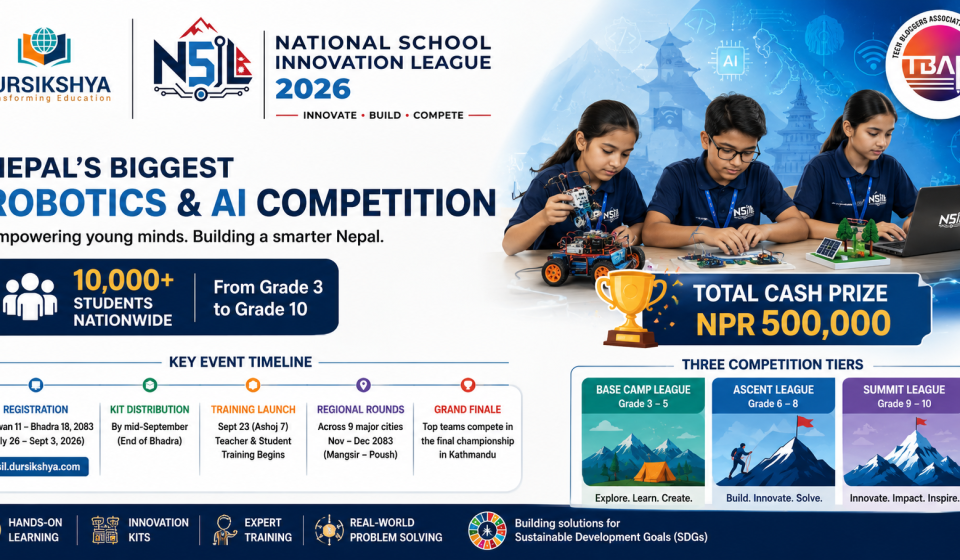

The nationwide competition expects to bring together around 10,000 students from Grades 3 through 10.
Hands-on Learning and Innovation Kits
Designed to shift the focus from theoretical knowledge to practical, project-based learning, the league offers a total cash prize pool of NPR 500,000 for the top-performing teams. Participating schools will receive comprehensive technical support, practical workbooks, and specialized Innovation Kits to conduct hands-on experiments.
“This is the first national-level innovation league organized at the school level in Nepal. It will play a crucial role in empowering young Nepali students with essential 21st-century technology skills like robotics and coding from an early age.”
— Krishna Prasad Pandey, CEO of Dursikshya Education Network
Key Event Timeline & Registration
Online registrations for the competition are officially open:
- Registration Window: Shrawan 11 – Bhadra 18, 2083 (July 26 – September 3, 2026)
- Registration Portal: nsil.dursikshya.com
- Kit Distribution: Innovation Kits will reach participating schools by mid-September (end of Bhadra).
- Training Launch: Specialized training sessions for teachers and students begin on September 23 (Ashoj 7).
- Regional Rounds: Regional competitions will take place across 9 major cities in Nepal through November and December (Mangsir and Poush).
- Grand Finale: The top-selected teams from the regional rounds will compete in the final championship in Kathmandu.
Three Competition Tiers
To ensure age-appropriate learning and fair evaluation, the National Innovation League 2026 is categorized into three distinct tiers:
- Base Camp League: Designed for younger students in Grades 3 to 5.
- Ascent League: Tailored for middle schoolers in Grades 6 to 8.
- Summit League: Built for high school students in Grades 9 and 10.
Each tier features customized projects, tailored Innovation Kits, and a transparent scoring system. Participating students will build tech-driven solutions aligned with the United Nations Sustainable Development Goals (SDGs) to address real-world community issues—marking a significant milestone in Nepal’s technical education landscape.