

August 15, Kathmandu.
Stakeholders have stated that while Nepal’s automobile sector is rapidly advancing towards electric and digital technologies, the country still lags behind in developing corresponding infrastructure, data management, research, cybersecurity, and skilled human resources.
They emphasized that with the increasing use of Artificial Intelligence (AI) in automobiles, Nepal should develop vehicles not just as imported and sold goods, but as areas for data, technology, research, and innovation.
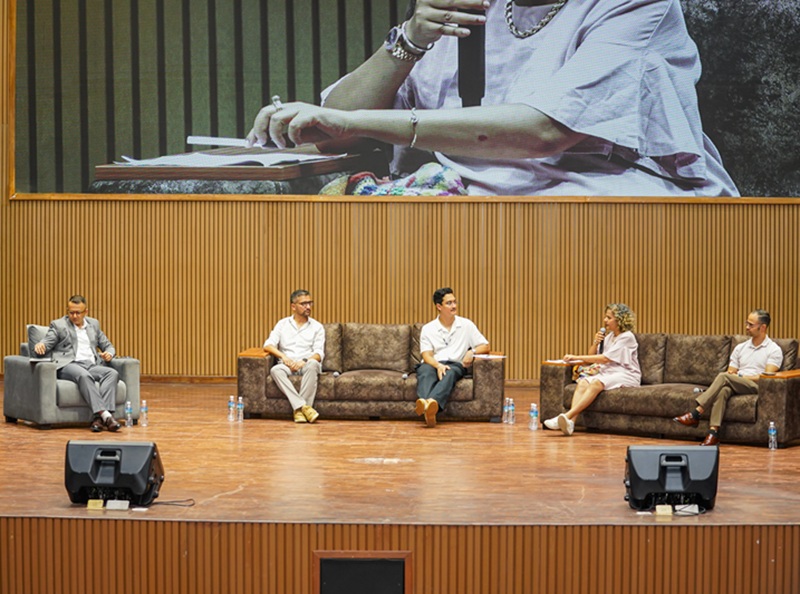
In the ‘AI and Automotive Technology: Driving the Future of Mobility’ dialogue organized by the Nepal Automobiles Importers and Manufacturers Association (Naima), representatives from industry, government, research, and academia shared their views on topics ranging from the potential of AI in automobiles to the necessary policies, infrastructure, and human resources required for it.
In the dialogue, Suryaansh Vaidya, Chief Executive Officer (CEO) of Vaidya Energy, stated that AI can be used not only in the automobile sector but also in traffic management, vehicle safety, and business operations. According to him, by analyzing data obtained from sensors and other devices installed in vehicles, users can be provided with safer, easier, and more effective services.
Vaidya stated that AI can be used for tasks ranging from identifying road conditions to improving driving styles. Similarly, he mentioned that by using AI in route planning, suitable charging stations can be suggested before a vehicle’s battery runs out. He also pointed out the possibility of connecting weather and rainfall data to the vehicle’s system to change traction control modes according to road conditions.
However, Vaidya stated that the use of autonomous driving in Nepal is not immediately feasible. He explained that the training data required for such technology typically comes from environments with good roads, clear lanes, and organized traffic, emphasizing the need for local data and research for Nepal’s distinct road and traffic conditions.
According to him, if data collected from vehicles can be shared with relevant government bodies, it could help identify road conditions, potholes, and other infrastructure-related problems. He stated that the goal of future mobility should not just be to sell new vehicles, but to develop systems that transport people safely, easily, and effectively from one place to another.
Similarly, Sanjay Paudel, Chief Advisor to the Ministry of Science, Technology, and Innovation, also highlighted the need for data management and government regulation in the modern automobile sector.
He stated that as the use of electric and technology-equipped vehicles increases in Nepal, the government’s role in regulating data generated by vehicles, quality testing, cybersecurity, and technology needs to be made more effective.
He emphasized the need for a clear system on how to collect data before and after importing a product, how to measure its quality, and how to use the acquired data.
Paudel also stated that there is a need for a policy-level study on the possibility of keeping cybersecurity and data within Nepal and the costs associated with it. He mentioned that as the use of software, connectivity, sensors, and digital systems in vehicles increases, vehicle-related data will also be linked to cybersecurity.
Advertisement
He also stated that along with establishing new innovation labs in Nepal, the government needs to prioritize which sectors to invest time and resources in. His view is that instead of investing in all technologies at once, research should be advanced by setting priorities based on Nepal’s needs and economic potential.
Similarly, Dr. Suman Thapaliya stated that despite the introduction of new technologies in the automobile sector, Nepal is weak in producing human resources accordingly. According to him, even though the use of electric and advanced vehicles is increasing in Nepal, sufficient attention has not been paid to technology, research, and skilled human resource development.
According to Thapaliya, most colleges and universities in Nepal still place more emphasis on traditional subjects like programming, web development, databases, and networking. However, there is a need to focus on producing human resources required for sensors, automation, AI, and other digital systems used in modern vehicles.
He stated that subjects such as AI, cybersecurity, embedded systems, robotics, edge computing, automotive software, and digital forensics should now be included in education with priority. He mentioned that simply studying embedded systems as a subject will not meet future needs, emphasizing that students should delve deeper into its advanced versions, robotics, edge computing, and automotive software.
Thapaliya presented a concept where, if given the opportunity, he would incorporate 60% core academics, 20% emerging technologies, and 20% industry applications into the current curriculum. He believes this would enable students to understand basic knowledge, practice new technologies, and grasp the real needs of the industry.
Additionally, Sandhya Sitaula, Executive Director of the Nepal Applied Mathematics and Informatics Institute for Research, stated that AI should not be viewed solely as a job-eliminating technology. According to her, AI is facilitating working styles and assisting in research, analysis, and identifying new possibilities. She also stated that the use of AI should be increased at the government level.
She stated that while the debate on AI primarily focuses on job losses, there is also a need for discussion on how technology is making work simpler and more effective. Sitaula emphasized that long-term investment is required to build a research ecosystem in Nepal. She believes that research should be seen as a long-term investment, not an expense, as results do not appear overnight.
According to her, data security has also become a crucial issue with the development of technology. She stated that Nepal should invest in the necessary infrastructure to keep data secure and move beyond the role of a consumer to become a country that contributes to technology and research.
Emphasizing the need for collaboration between the government, the private sector, and research institutions, she stressed that research conducted in Nepal should be used to solve local problems. She stated that if a problem in any sector can be solved using local data, an environment should be created to implement such research in practice.
Similarly, the views expressed in the Naima dialogue indicate that Nepal’s automobile sector is no longer limited to just importing, selling, and operating vehicles. With AI, sensors, software, connectivity, data, and automation transforming the nature of vehicles, Nepal also needs to adapt its policies, education, research, and infrastructure accordingly.
The speakers in the dialogue highlighted the necessity of prioritizing mechanisms for secure and useful sharing of industry-generated data with government and research institutions, research covering local road and traffic conditions, cybersecurity, modern equipment for quality testing, AI infrastructure, and the development of tech-friendly human resources.
For more: AI in Vehicles Challenges Nepal