


13 Bhadra, Kathmandu.
Culture expert Dr. Govinda Tandan has stated that the popular belief that Gai Jatra began during the reign of Pratap Malla is historically incomplete. He explained that since Gai Jatra (Saayat) is mentioned in the Gopalraj Vamshavali (genealogy) as early as Nepal Sambat 503-504, this tradition has been in practice much longer than Pratap Malla’s time.
In a conversation with Nepal News Bank about the cultural, religious, and historical aspects of Gai Jatra, Tandan stated that in Nepal, festivals are harmoniously linked with nature and human life due to the Chandrayan Panchang (lunar calendar) which follows the moon’s movement.
According to him, as India gradually prioritized the solar calendar after British rule, the date-centric practices weakened. In Nepal, however, the tradition of celebrating festivals according to specific dates (tithi) continues, he noted.
He explained that in an agrarian society, the social and religious importance of dates (tithis) that come after rice planting and weeding gradually increases. Festivals like Gunla Parva, Gai Jatra, Janai Purnima, Sohraw Shraddha, Dashain, Tihar, and Chhath are linked to this seasonal cycle, forming a continuously recurring cultural rhythm in society.
Tandan stated that at the core of Gai Jatra lies Vedic respect for the cow. ‘The cow is considered the mother of the world,’ he said, ‘and modern science has also begun to acknowledge the utility of milk, curd, cow dung, and cow urine in various ways.’ He added that it is now being confirmed that even the old practice of plastering houses with cow dung has scientific bases related to cleanliness and health.
According to him, Gai Jatra is a memorial festival connected with death. The tradition of taking out a procession with a cow or a symbol of a cow from households that have lost a family member within the past year is especially prevalent in the Hindu Newar community of the Kathmandu Valley. He explained that this tradition is linked to the religious belief that it helps the soul easily cross the Vaitarani River described in the Puranas.
His analysis is that for this reason, Gai Jatra has played a role in transforming individual grief into collective remembrance and social participation. He stated that there are two different historical perspectives regarding the origin of Gai Jatra.
He stated that although the Bhasha Vamshavalis written in the 19th century mention that Gai Jatra was started to console the queen after the death of Pratap Malla’s son, Chakrapatiendra Malla, that is not the definitive historical conclusion. He mentioned that the mention of ‘Saayat’ in the Gopalraj Vamshavali is evidence from before Pratap Malla’s time.
However, he clarified that Gai Jatra is not directly mentioned in more than two hundred inscriptions from the Lichhavi period. He stated that although the importance of cows, Nandi, and Kamdhenu was widely evident in inscriptions, sculptures, and coins during that time, there was no mention of it as a Jatra (procession). Therefore, Tandan’s view is that while religious respect for the cow is ancient, regarding the question of when Gai Jatra began, the Gopalraj Vamshavali is currently the oldest available written evidence.
Gai Jatra is also a Mirror of the City
When Gai Jatra processions took to the streets of Kathmandu, it was not merely a religious journey carrying the memory of deceased relatives. It carried the news of the city. Which house had a death, what events transpired in the palace, who did what in society, and what were the weaknesses of rulers to common people? The crowds of Gai Jatra and the satirical caricatures that emerged with them would reveal many things.
According to Tandan, it is this social character of Gai Jatra that has made it unique in the cultural life of Kathmandu. He states that Gai Jatra is celebrated in different forms depending on the place. In places like Kathmandu, Bhaktapur, Patan, Devpatan, Kirtipur, Nala, and Banepa, the style, duration, costumes, and presentation of the procession differ. He mentions that in some places, the Jatra lasts for one day, in others for three days, and in some, even for seven days.
Traditionally in Kathmandu, there was a custom of decorating cows or calves and taking them out in the procession. Now, as it has become difficult to find cows, people themselves have started presenting themselves in the form of cows. In Bhaktapur, however, the procession is taken out in a different style, by placing photographs of the deceased. In Devpatan, there is a tradition of decorating people and presenting them in satirical and entertaining forms.
‘Gai Jatra is not just religious faith; satire and farcical comedy also entered it,’ says Tandan, ‘It also developed as a means to make people laugh, entertain them, and satirize.’
Advertisement
Today, there are countless means of entertainment. But in the past, the situation was not like that. At that time, annual processions and festivals were the main opportunities for public entertainment. Therefore, Tandan understands that the practice of making people laugh, satirizing, and entertaining those who came to the Jatra gradually became an integral part of Gai Jatra.
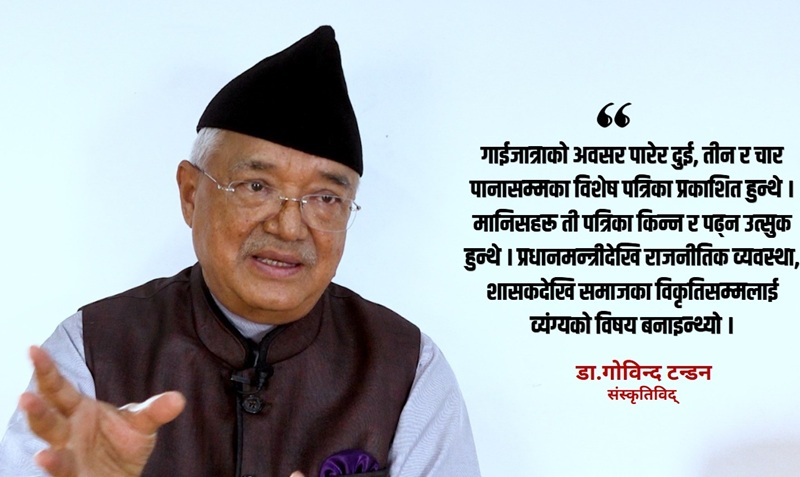
He explains that particularly before the year 2037 BS (1980-81 AD), satirical content associated with Gai Jatra had a significant impact. Special magazines of two, three, and even four pages were published on the occasion of Gai Jatra. People were eager to buy and read those magazines. Everything from the Prime Minister to the political system, from rulers to societal ills, was made a subject of satire.
But now that situation has changed. ‘Why wait for Gai Jatra itself, when there’s always a ‘Gai Jatra’ (i.e., constant satire/entertainment)?’ Tandan says a narrative like this has also begun to form. According to him, with the expansion of communication and entertainment media, the old social role of Gai Jatra has also gradually weakened.
However, Gai Jatra had another important role. In the absence of modern communication facilities for information dissemination, Jatra teams would carry news of deaths as they moved from one part of the city to another. People would gather at public places like Kathmandu’s Hanuman Dhoka and the area around the 55-window palace in Patan to watch the Jatra. From there, the community would also receive information about whose house had a death.
Tandan states that the tradition of Gai Jatra teams from Kathmandu, Patan, and Bhaktapur passing through the palace is also linked to this social connection. In the past, processions were taken out even from families in the royal palace who had experienced a death. The custom of honoring the Jatra teams at the palace and distributing food to them still continues in some places.
Therefore, Gai Jatra does not just commemorate the deceased. It preserves the social memory of a city—telling the story of whose house had a death, what changes occurred in society, and how traditions evolved over time.
According to Tandan, it is not unusual for the form of Gai Jatra to change. Some traditions have disappeared over time. Some have emerged in new forms. But even amidst changes, its core character—remembrance of the deceased, social participation, and satire that shows society its own face—still remains. For this reason, Gai Jatra has become more than just a festival; it is a mirror of society.
Lakhe Naach: A Folk Tradition that Arouses Curiosity in Children’s Minds
The Lakhe Naach (Lakhe dance) seen in the Jatra festivals of the Kathmandu Valley is a cultural tradition that entertains people while also arousing curiosity and inquisitiveness in children. According to culture expert Tandan, although the main purpose of Lakhe is to entertain people, its impact is even deeper on children.
Parents even coax or scare children by showing them the Lakhe, which is presented with long hair and a frightening appearance. The saying ‘If you don’t eat, Lakhe will come’ is an example of this.
However, children do not initially realize that there is actually a human inside the Lakhe’s form. Tandan states that this creates curiosity in them, as if it were a character from another world or realm.
Since Lakhe is presented in various Jatra and festivals in forms related to deities, its dancing time and occasion are also determined by tradition. He says that when Lakhe is not seen in a Jatra, people feel that the festival is incomplete.
According to Tandan, along with entertainment, Lakhe Naach also develops in children the habit of questioning, exploring, and understanding new things.
For more: From Ancient Rituals to Social Satire