
Stakeholders Conclude: Collaboration Between Education and Industry Essential to Make Going Abroad a Choice, Not a Compulsion, for Youth

September 1, Kathmandu.
Stakeholders have emphasized the need to bridge the gap between education, skills, entrepreneurship, and industry to create opportunities for youth within Nepal and transform the compulsion of going abroad into a choice.
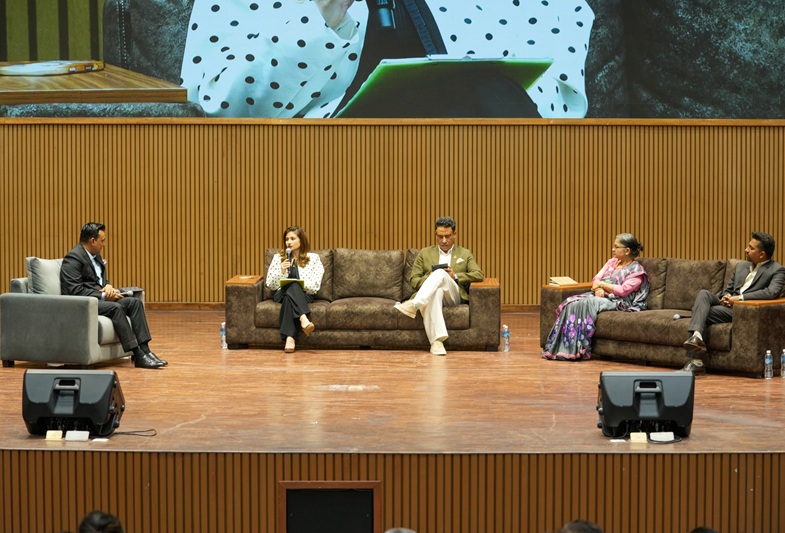
They expressed these views during a dialogue organized on the occasion of the NAIMA Mobility Expo 2026, hosted by the Nepal Automobiles Importers and Manufacturers Association (NAIMA), on the topic of ‘Bringing in talent and sending out workers: Bridging the gap in education, skills, and entrepreneurship in Nepal through processes’.
Entrepreneur and Member of Parliament, Bidushi Rana, stated that going abroad from Nepal should be a choice for youth, not a compulsion. She mentioned that despite ample possibilities in sectors like industry, information technology, hotels, and automobiles within Nepal, youth are compelled to go abroad due to policy complexities and a lack of opportunities.
She stated that to retain youth within the country, the government and private sector must collaborate to create an employment and entrepreneurship-friendly environment. She suggested implementing a ‘one-window system’ to eliminate the need to visit various offices for business registration, taxes, permits, and financial resources when starting a business.
NAIMA founder and entrepreneur Saurav Jyoti stated that Nepal’s automobile sector could transition from ‘Make in Nepal’ to ‘Made in Nepal’ within the next 5 to 10 years. For this, he emphasized the need to develop local production of parts and components, along with the assembly industry and its supply chain.
He highlighted a significant gap between the education sector and the private sector, emphasizing the need to develop curricula aligned with industry requirements. He noted that the private sector generates a substantial portion of employment and stated that if an environment of trust and security for entrepreneurs and investment could be fostered, the economy would gain momentum.
Associate Professor Lochan Kendra Devkota of Thapathali Campus stated that simply completing studies from university does not mean students can immediately perform all necessary tasks in the industry the very next day.
Advertisement
He stated that since universities strengthen theoretical foundations, collaboration between universities, industry, and the government is necessary for the practical skills required in industry.
He stated that the system, from curriculum development to internships, research, student projects, and employment, needs to be linked with industry. He also suggested increasing investment in university research and student projects.
Professor Bhagwati Sedai of Padmakanya Campus under Tribhuvan University stated that youth should not be discouraged by creating a narrative that there are no opportunities in Nepal.
Stating that opportunities for education, skills, and employment can be created within Nepal, she emphasized the need for collaboration between the government, private sector, educational institutions, and youth. She further stated that curricula should be developed through discussions with industrialists and entrepreneurs about the human resources required by industries, adding that current policies related to entrepreneurship and self-employment have not been effectively implemented in practice.
She suggested encouraging the private sector to invest in skill development. All four speakers participating in the dialogue emphasized the need for direct collaboration with industry, practical skills, and effective internships and apprenticeships to reduce the gap between education and employment.
They expressed the view that if opportunities can be created in Nepal, the trend of skilled youth going abroad can be reduced, and an environment can be created for those who have gone abroad to return home.
For more: Nepal Can Turn Brain Drain into Choice