
Vedic Significance of Rakshabandhan: Astrologer Mukunda Nepal Claims ‘Rakhi’ is a Foreign Imitation

12 Bhadau, Kathmandu.
On the day of Janai Purnima, Hindu devotees have a tradition of changing the sacred thread (Yajnopavit) and wearing the Rakshasutra (protective thread) with special reverence and faith. Especially, men from Brahmin, Kshatriya, and Vaishya communities who have completed the Upanayana ritual customarily wear a new sacred thread consecrated according to Vedic rituals.
Yajnopavit is known by various names including Janai, Upavit, Yagyasutra, and Brahmasutra. There is a tradition of wearing the consecrated sacred thread over the left shoulder and under the right arm. According to Hindu philosophy, human life is associated with 16 rituals, among which the Upanayana ritual is one important ceremony.
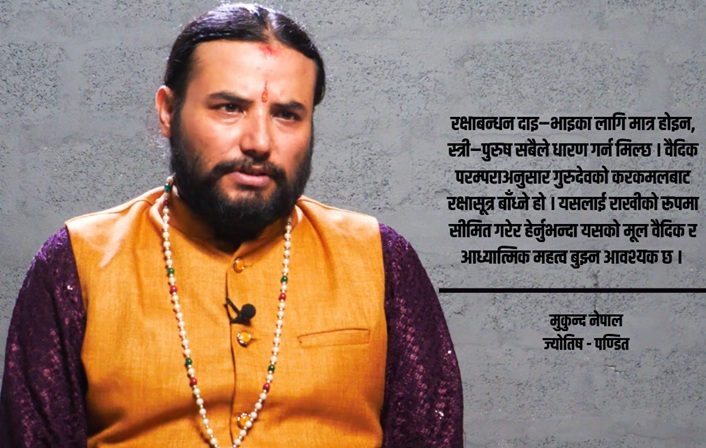
Speaking with Nepal News Bank, Astrologer Pandit Mukunda Nepal explained the Upanayana ritual as an important process for approaching knowledge and Brahman (the ultimate reality).
He said, ‘Especially among followers of Vedic Sanatan Dharma, there are 16 rituals. Among them, rituals from conception to death are extremely important. Among rituals like Chudakarma, Upanayana, Vedarambha, and Samavartana, Yajnopavit is worn during the Upanayana ritual. Yajnopavit is also called Brahmasutra. Upanayana is a ritual associated with the awakening of the third eye for knowledge.’
According to tradition, after childhood, the Bratabandha ceremony is duly performed. After the Guru or priest imparts the Gayatri Mantra initiation, the Yajnopavit is worn with a vow to proceed on the path of Dharma, truth, and devotion. Yajnopavit is not merely a thread worn on the body but is also considered a symbol of discipline, knowledge, and spiritual devotion.
According to Pandit Nepal, those who wear Yajnopavit customarily perform Sandhyavandan and Japakarma (chanting) according to tradition. It is believed that this invokes divine devotion, brilliance, and spiritual power in an individual.
He said, ‘Individuals who have worn Yajnopavit traditionally perform Japakarma and Sandhyavandan in the morning and evening. Although not everyone can perform Trikal Sandhya now, its fundamental principle is to wish for divine brilliance and power upon oneself. Therefore, Yajnopavit is an extremely important matter.’
It is not necessary to change the Janai only on the day of Janai Purnima. According to religious beliefs and traditions, the Janai must also be changed during periods of impurity (ashauch) or in certain religious circumstances. However, Shrawan Shukla Purnima is considered a special day for ritually wearing a new Janai.
On this day, it is customary to bathe early in the morning and go to a river, lake, or reservoir to worship and offer libations (tarpan) to the sages. Afterwards, the Yajnopavit consecrated with Vedic mantras is worn.
He said, ‘Yajnopavit cannot be worn as an ordinary thread. It is worn only after being consecrated by Vedic mantras and worshipping Brahma, Vishnu, Maheswara, and the Tantudevata (deity of threads). On Janai Purnima, by wearing a new Yajnopavit, one wishes for an increase in brilliance and power upon oneself.’
According to Pandit Nepal, although every Purnima has its own religious and cultural significance, Shrawan Shukla Purnima is celebrated separately due to the special importance of Rishi Tarpani and Janai Purnima on this festival.
He stated that the act of wearing Yajnopavit (Janai) should not be understood as merely linked to caste identity. He explained that those who have completed the Upanayana ritual must wear Yajnopavit, and its main meaning is connected to self-discipline, divine brilliance, and the development of spiritual consciousness.
Advertisement
‘Yajnopavit is not just a thread. It is worn with the desire for the divine brilliance and power residing within it. Practices like Shikhabandhan and Yajnopavit are also connected to an individual’s self-protection. It is believed that after wearing the Brahmasutra, an individual develops the capacity to understand the divine state (Brahmabhava).”
Along with Janai Purnima, the tradition of Rakshabandhan, or wearing the Rakshasutra (protective thread), is also associated. According to Vedic beliefs, there is a custom for a Guru or priest to tie the Rakshasutra after reciting mantras. The Rakshasutra is considered a religious shield that protects against various negative forces, crises, and anomalies.
In this process, there is a tradition of chanting the mantra: ‘Yena baddho Bali Raja Danavendro Mahabalaha, Tena twam pratibadhnaami rakshe ma chala ma chala’ (By which the mighty King Bali, the great Asura king, was bound, by that I bind you, O Raksha, do not waver, do not waver).
He said, ‘Rakshabandhan is a shield of protection. In ancient times, there is a religious belief that King Bali and Indra also wore the Rakshasutra consecrated by mantras for protection from danger and for victory. The Rakshasutra is worn to overcome the six vices within humans, such as desire, anger, greed, attachment, ego, and jealousy, and to protect against negative emotions.’
He mentioned that recently, the practice of celebrating Rakshabandhan differently by associating it with ‘Rakhi’ has increased, stating that in Vedic tradition, both men and women customarily receive the Rakshasutra from a Guru or priest.
He said, ‘Rakshabandhan is not just for brothers; both men and women can wear it. According to our Vedic tradition, it is customary to have the Rakshasutra tied by the benevolent hands of a Gurudev. Instead of viewing it merely as a Rakhi, it is essential to understand its original Vedic and spiritual significance.’
He stated that the custom of celebrating Rakshabandhan by calling it ‘Rakhi’ is not part of Vedic rituals and is a distortion and incongruity.
He said, ‘This is considered a distortion and an incongruity. What’s happening is that Rakshabandhan is about wearing the Rakshasutra; there is no concept of Rakhi. Currently, we are imitating Western or other traditions. It is our Rakshabandhan, not Rakhi. The practice of tying Rakhi was not a tradition in Nepal’s Vedic civilization. It is currently being adopted from India or other countries, but according to Vedic civilization, it is Rakshabandhan that should be worn.’
He stated that the thread worn as Rakshabandhan is a protective shield, and Rakshabandhan is something worn to protect oneself from negative forces.
‘It is a shield of protection. When wearing this, it’s about self-defense. In ancient times, during war, Indra also wore it from the benevolent hands of Brihaspati and succeeded in defeating the demons. We also have six enemies within us: desire, anger, greed, attachment, ego, and jealousy. Rakshabandhan is something worn to overcome these enemies, to awaken the feeling of ‘Aham Brahmasmi’ (I am Brahman), to understand that God resides within me, and to protect oneself from negative forces.’
Thus, Janai Purnima has been celebrated not merely as a festival for changing the Yajnopavit, but as a special festival for expressing reverence to sages, resolving to advance on the path of knowledge and truth, and wishing for self-protection and spiritual purity.
For more: Vedic Roots of Rakshasutra