

Bureaucracy Demoralized Due to Non-Passage of Civil Service Act: Former Secretary Kewal Prasad Bhandari

21 Bhadra, Kathmandu.
Kewal Prasad Bhandari, Former Secretary, Government of Nepal: Bureaucracy Demoralized Due to Non-Passage of Civil Service Act; The current government has the last opportunity to make reforms: Former Secretary Bhandari
Former Secretary of the Government of Nepal, Kewal Prasad Bhandari, has stated that even after almost a decade since federalism was implemented, the Federal Civil Service Act has not been passed, leaving the bureaucracy mired in confusion, demoralization, and a crisis of career development.
In a conversation with Nepal News Bank, he stated that without legal certainty, effective training, and social security, the federal governance system cannot deliver the expected services. According to Bhandari, the morale of employees has weakened as the task of restructuring the employee administration according to the federal structure remains pending.
He stated that according to the new structure requiring work in three levels of government, employee career development, promotion, and work procedures could not be made timely. He mentioned that employees need clarity about their service life. ‘Employees need certainty about how long and where they will work, when they will be promoted, what benefits they will receive, and what their future will be,’ he said.
He stated that contradictory debates regarding retirement age, service period, and transfers have created an environment of insecurity and fear among employees. Bhandari mentioned that while the draft of the Federal Civil Service Act proposed a retirement age of 60 years, discussions about retiring at 55 years have created further confusion among employees. His analysis suggests that some employees might have voluntarily left service due to this reason.
He stated that even though widespread reforms in employee administration were expected after the formation of a majority government, that expectation could not be fulfilled. ‘There was a belief that service delivery would be effective and new paths would open in employee administration after a nearly two-thirds government was formed, but that was not seen,’ he said.
Former Secretary Bhandari commented that the tendency to view employee administration as less important than politics also reduced employee morale. According to him, since the government formulates policies and employees implement them, the role of both in public service is equally important.
Regarding the government’s decision to limit the number of ministries from 21 to 18, he stated that even though he considered it a matter of governmental authority, it would affect the high-level hierarchy. He mentioned that a reduction in ministries would limit opportunities for posts like Secretary, Joint Secretary, and Under Secretary, thus impacting career development. However, he clarified that a reduction in ministries would not cause significant problems in daily operations.
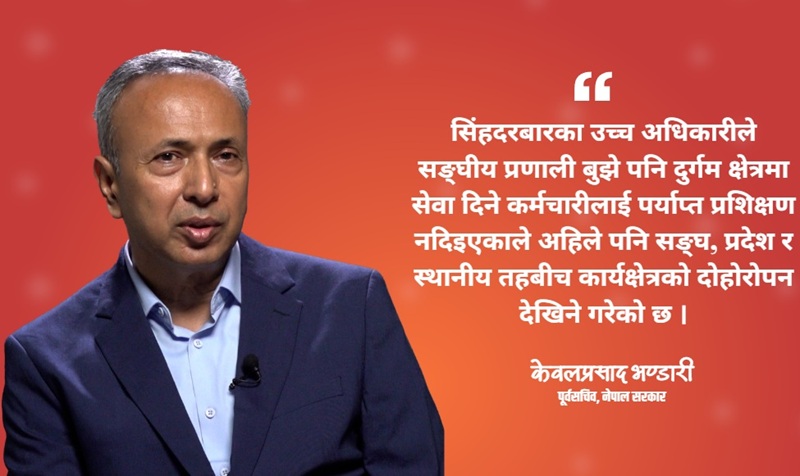
Bhandari stated that not forming a high-level administrative reorganization commission to prepare the bureaucracy according to the new governance system after federalism was implemented was a major weakness. According to him, even though high officials in Singha Durbar understood the federal system, a lack of adequate training for employees serving in remote areas means that duplication of work areas is still observed among the federal, provincial, and local levels.
He stated that some positive reforms have been included in the Federal Civil Service Bill, which is being prepared for submission to Parliament. He mentioned that the bill contains new provisions such as clarifying the objectives of the civil service, clustering in the reservation system, provisions for leadership evaluation, the formation of a Civil Service Board, and monthly performance evaluation of employees above officer level.
However, he believes that the federal employee administration will not be competent with just this. He suggested that the age of entry into service should be reconsidered, employees should be recruited at a younger age and given systematic training, and mandatory training for assistant-level employees should be restarted. Furthermore, he stated that new laws alone cannot transform the bureaucracy until improvements are made in health, social security, child care, and economic-non-economic benefits.
Bhandari stated that the current government still has a significant opportunity to further amend the Federal Civil Service Act and build a citizen-centric, modern, and accountable bureaucracy.
Civil Service Reform Not Possible Without Human Compassion
Bhandari stated that even though the proposed Federal Civil Service Act includes topics of promotion, career development, and social security, further improvements are still needed to genuinely boost employee motivation.
Advertisement
He stated that by merely limiting employees to salaries and allowances, the state cannot achieve the expected service delivery. In a conversation about the provisions of the Federal Civil Service Act, Bhandari mentioned that the promotion system appears to have been advanced without data-based scientific analysis.
He stated that with the current provision of seven years to move from one level to another, it appears to take up to 14 years to reach the subsequent level. He expressed the view that the promotion system should be reconsidered by analyzing available manpower, age, and service period.
‘Promotion is a matter connected with employee motivation,’ he said, ‘but as the structure of ministries and departments shrinks, posts will decrease and retirements will also occur, so its impact might not be seen as expected.’
Bhandari accused the government of failing to view employee administration with human compassion. According to him, there is a mindset that employees will work once they are paid, whereas the state should also prioritize employee career development, social security, family education and health, and post-retirement life.
He stated that for employees who serve for more than 30 years and retire at 60, provisions are needed to secure their post-retirement life. ‘It is not easy to start new work after retirement. Therefore, the state must ensure the basis for livelihood,’ he said.
Improvements Needed in Transfer and Training Systems
Former Secretary Bhandari emphasized the need to make the employee transfer system scientific. He stated that if the inequality of opportunities among employees working in the mountains, Terai, and the capital cannot be removed, it would affect work efficiency.
He also pointed out the need to provide employees with opportunities for regular training, study, and fellowships. ‘It’s not enough to just join the service after completing university studies,’ he said, ‘The government should provide opportunities for study within the country and abroad for necessary skills, but currently such programs are declining.’
Suggestion to Use Provident Fund Savings for Social Security
Bhandari stated that the large savings in the Employees’ Provident Fund and Citizen Investment Trust could be effectively utilized for employee social security. He commented that even though those institutions could play a greater role in the education, health, and housing sectors for employees, military, and police families, work has not been done accordingly.
He stated that in Nepal’s socio-cultural context, the provision of one’s own housing is an important issue for citizens, so the state should introduce special programs in that direction.
Demand for Equal Opportunities for Employees Working in Remote Areas
Bhandari stated that discrimination based on access in promotion and opportunity distribution should be ended. He mentioned that if employees close to leadership get faster promotions while those working in remote areas fall behind, employee administration cannot be effective.
According to him, even though the Federal Civil Service Act includes provisions for health insurance, social security, and services-benefits, only if it can be implemented fairly and equally in practice will there be an improvement in civil service morale and service delivery.
For more: Civil Service Act Delay Demoralizes Bureaucracy