
Extravagance must be stopped to preserve the true essence of Teej: Culture expert Dr. Govinda Tandon

September 15, Kathmandu.
Culture expert Dr. Govinda Tandon has stated that Haritalika Teej should not be limited to merely a religious festival, but understood as a historical medium for Nepali women’s pain, resistance, and social expression.
Stating that in recent years the original form of Teej has become market-oriented and ostentatious, he emphasized the need for conscious efforts to preserve its cultural essence.
In an interview with Nepal News Bank, Dr. Tandon recalled that Teej songs in the past were a medium for women to openly express their experiences of discrimination, neglect, and exploitation by society.
‘At one time, by listening to Teej songs, one could understand the real condition of women in society,’ he said, ‘Now, that intimacy and spontaneous expression are gradually diminishing.’
According to him, most Teej songs are now limited to recorded music and market competition. He stated that the tradition of women gathering in villages to immediately sing ‘dohori’ (call-and-response folk songs), satirize, ask and answer questions, and express their feelings through impromptu poetry is gradually disappearing.
Tandon specifically mentioned that the old Teej culture of the Pashupati area has changed significantly. According to him, in the past, the forests of Bankali and Mrigasthali resonated with Teej dohori songs. Thousands of people used to gather in those places to listen to the songs.
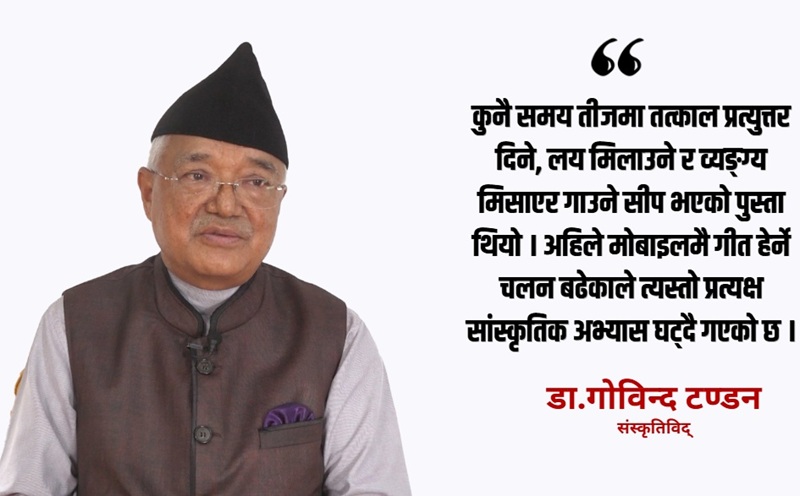
‘At that time, there was a generation skilled in giving immediate responses, matching rhythm, and singing with satire,’ he said, ‘Now, with the increasing trend of watching songs on mobile phones, such direct cultural practice is diminishing.’
According to him, the weakening of that tradition of impromptu poetry is also a sign of a shift in the cultural attraction of the new generation. Tandon stated that Teej is no longer limited to a single caste or community. He added that since Teej is celebrated wherever Nepalis reside worldwide, it has taken the form of a common festival of Nepali identity.
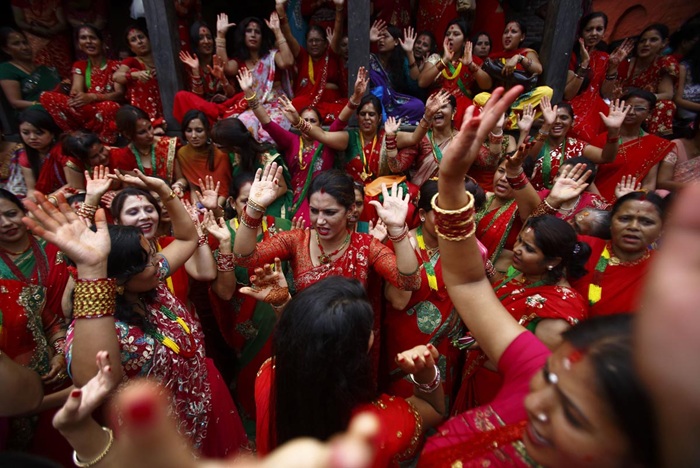
He gave the example of the Newar community, stating that although the tradition of celebrating Teej for religious reasons was limited in the past, the new generation has now started adopting it as a festival. ‘The attraction of red attire, bangles, ‘pote’ (beads), dancing, singing, and collective celebration has led to its expansion in all communities,’ he said.
Advertisement
His view is that abroad, the tradition of celebrating Teej as a symbol of Nepalis, rising above ethnic boundaries, has become even stronger. According to Tandon, social media has brought about a significant change in the style of celebrating Teej.
While collective gatherings were the main medium before, people now also show their participation through Facebook, Instagram, and other digital platforms. However, he indicated that this has, to some extent, weakened traditional collective cultural practices.
Extravagance in Teej should not be allowed to increase
Tandon expressed concern over the increasing extravagance and exhibitionist tendencies during Teej. According to him, culture should be preserved in a way that is accessible to everyone, and should not be made a medium for competitive display.
‘If extravagance that not everyone can afford increases, it can create a sense of inferiority and resentment in other communities or economically weaker people,’ he said.
He recalled that a few years ago, the excessive commercialization of ‘dar’ (a special feast) programs held in party palaces months before Teej had increased, and some improvements were seen after media, culture experts, and the state raised awareness about it. However, he stated that continuous attention is needed to prevent such tendencies from increasing again.
Culture is Nepal’s Identity
Dr. Tandon stated that Teej is an important medium for introducing Nepal’s cultural identity to the world. He mentioned that foreign photographers, writers, and documentary filmmakers come to the Pashupatinath area to capture the sight of women adorned in red attire during Teej, which, he said, enhances Nepal’s cultural appeal.
‘Teej is not just a worship, it is also a reflection of Nepal’s lifestyle, colors, beauty, and social relationships,’ he said. According to him, preserving culture means safeguarding its originality. For this, he emphasized the need to remove distortions and advance traditions in a timely manner.
‘If Teej can be celebrated according to one’s capacity and means, away from extravagance, with the spirit of preserving culture, it will strengthen both Nepali society and Nepal’s identity,’ said Tandon.
For more: Preserving True Essence Haritalika Teej