
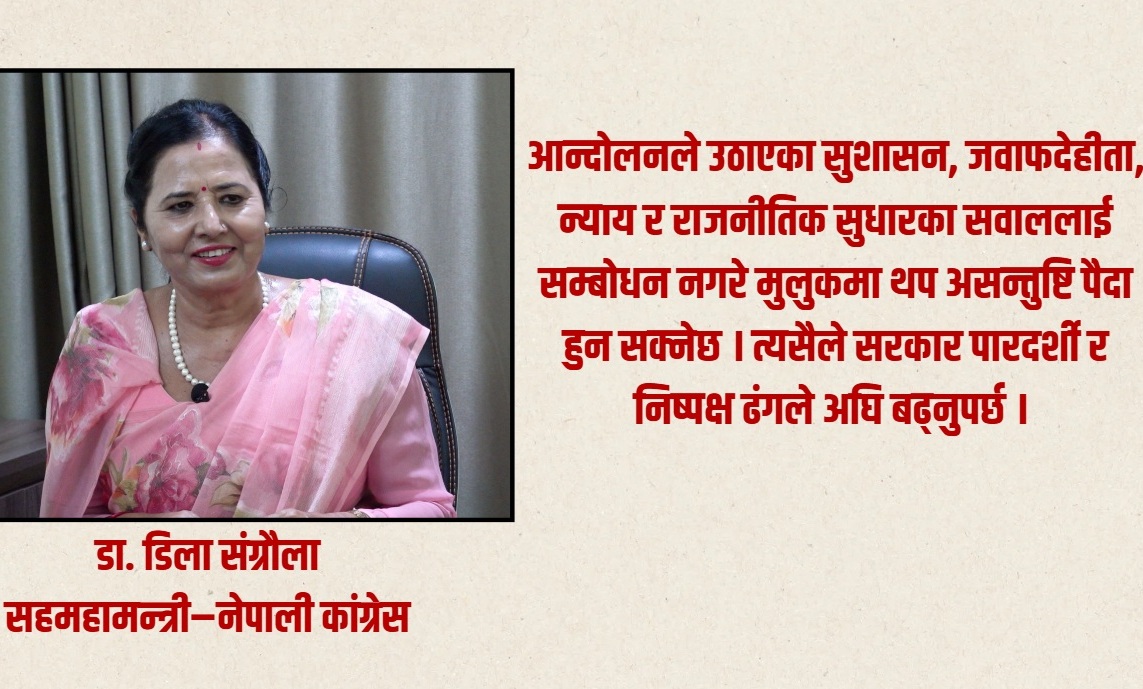
Failure to Impartially Investigate Incidents During GenZ Movement is Unfortunate: Dr. Dila Sangroula, Joint General Secretary – Nepali Congress

September 9, Kathmandu.
One year has passed since the GenZ movement, which took place on September 9 and 10 last year, demanding an end to corruption, disorder, good governance, and political accountability, brought significant change to Nepali politics.
In a conversation with ICT FRAME MAGAZINE regarding this, Dr. Dila Sangroula, Joint General Secretary of the Nepali Congress, alleged that even after one year of the GenZ rebellion, the current government has failed to advance according to its objectives.
She claimed that the government has failed to fulfill the public’s expectations for good governance, zero tolerance for corruption, effective service delivery, and a prosperous Nepal.
According to Sangroula, the main objective of the GenZ rebellion was to establish transformation, good governance, and zero tolerance for corruption in Nepal, as well as to provide prompt and efficient services to citizens from the state.
She stated that based on this, political parties were also expected to transform themselves and move forward in a new way.
Stating that the current government was formed on the foundation of the GenZ movement after the elections, she commented that despite the great hope and trust the public placed in the government led by Prime Minister Balendra Shah, which carried the agenda of the GenZ rebellion, work has not progressed accordingly.
She accused the government of appearing weak in matters of corruption control and good governance. She stated that it is the Nepali Congress’s view that the assets of individuals who reached high positions after the political change of 1990 (2046 BS) should be investigated, and all past corruption case files should be opened.
She said that the government has not been able to effectively advance this issue.
She said, ‘We have stated that all individuals who reached high positions after the 1990 change should have their assets investigated, and all case files should be opened. But it seems the government has broken down on this issue; it does not appear to be moving forward.’
She mentioned that even though the public should receive effective services directly from Singha Durbar, the government has appeared weak in disaster management itself. She stated that particularly in the floods in Bhote Koshi and the subsequent disaster, the government’s presence in rescue, relief, and rehabilitation efforts has not been effective.
She stated that the federal government alone is not the only government, emphasizing the need for effective coordination among federal, provincial, and local levels. She commented that the current government has not demonstrated effective dialogue and understanding even with local governments, which are directly connected to the people.
Stating that transformation is not the agenda of just one party or group, she said it is the government’s responsibility to unite all political parties and move forward in nation-building. She stated that since Parliament is the primary forum where the people’s sovereignty is exercised, the Prime Minister must be accountable to Parliament.
She said, ‘Parliament is the sovereign place of the people, where debates take place, and the Prime Minister must answer the questions of the Members of Parliament. However, a situation has arisen where MPs continuously have to raise their voices just for the Prime Minister to be accountable to Parliament.’
According to her, the Nepali Congress has embraced transformation and good governance within the party under the leadership of Gagan Kumar Thapa after the special general convention. She stated that they (Nepali Congress) are also a part of the government.
She stated that the Congress has adopted a policy of supporting the government’s positive works and pointing out its weaknesses.
She stated that the incidents of September 9 and 10 that occurred during the GenZ movement have not been impartially investigated. She mentioned that during the September 9 protest, youth, including children, were shot, and the demands of the families of those injured and martyred have still not been addressed.
Advertisement
Joint General Secretary Sangroula stated that although the GenZ rebellion brought the country to the brink of major change, the voices of the people have been suppressed even more after the movement. She said that even today, when citizens raise their demands and voices, the government baton-charges them instead of listening.
She said, ‘The GenZ rebellion brought the country to the brink of a major transformation. But even today, when voices are raised, the government doesn’t listen; instead, there are baton charges. It seems the government itself, which came to power on the strength of GenZ, is engaged in suppressing voices,’ she said.
According to Sangroula, during the incident on September 9 of the movement, young children were shot. She expressed dissatisfaction with the government, stating that the demands of the families of those injured and who lost their lives during that period have still not been addressed.
‘On the one hand, young children were shot during the September 9 protest, and the demands of the injured and the families of the martyrs have not been addressed yet,’ she said. ‘On the other hand, during the destructive activities on September 10, public and private properties including the Parliament building, Singha Durbar, and the Supreme Court were burned, but the government failed to conduct an impartial investigation into that. One group got power, while the other only got pain.’
She stated that it is ironic that the government, which was reportedly formed on the strength of GenZ, appears to be involved in suppressing voices.
Similarly, she alleged that the government has failed to conduct an impartial investigation into the destructive activities that occurred on September 10 of the movement. She stated that there should be an impartial investigation into the incidents of arson and damage to public structures and private property, including the Parliament building, Singha Durbar, and the Supreme Court.
According to her, if the issues of good governance, accountability, justice, and political reform raised by the movement are not addressed, further dissatisfaction could arise in the country. Therefore, she stated that the government must proceed transparently and impartially.
She claimed that dissatisfaction in the market has increased due to the government’s behavior towards the private sector. She stated that the tendency to first detain traders and businessmen and only then listen to their concerns has negatively impacted industries and businesses.
Stating that the country’s economy is becoming increasingly dependent on loans and remittances, she said that the government has failed to create an environment for youth employment within the country. She mentioned that despite the commitment made during elections that ‘no one needs to go abroad,’ a large number of young people are now forced to go abroad for employment.
She mentioned that due to the failure to formulate necessary laws for Non-Resident Nepalis, investment from foreigners and Non-Resident Nepalis has not been able to come in as expected. She stated that the exodus of youth should be stopped by creating an environment for investment and employment in the agriculture, water resources, tourism, and industry sectors.
Sangroula stated that radical reforms are also needed in the education and health sectors. She demanded an end to the situation where expensive education does not guarantee employment, and arrangements should be made for the general public to receive easy and quality health services.
She stated that the public is facing problems due to rising inflation, black marketing, and the scarcity of basic necessities like gas and petrol. She also stated that the government needs to implement concrete legal and institutional reforms in cases of violence and rape against girls.
She stated that the Prime Minister’s style of coming to Parliament ‘like an express train’ and leaving without listening to the MPs does not demonstrate a parental role.
She stated that in difficult circumstances, the Prime Minister should call an all-party meeting and gain the trust of all political parties. She mentioned that during disasters, social tensions, and national crises, the government should collaborate with all parties rather than proceeding alone.
Stating that the GenZ rebellion brought the country to the brink of a major transformation, she said there is still an opportunity to work according to the spirit of that movement. She mentioned that while the government has an opportunity to maintain public trust, it should use this not for stunts, but for good governance, service delivery, and results-oriented work.
For more: Dila Sangroula Criticizes Balen Government