
If gas comes by imprisoning businessmen, we will be imprisoned: Diwan Bahadur Chand, Chairman of Nepal LP Gas Industry Association

September 28, Kathmandu.
In recent times, with the shortage of cooking LP gas across the country, including the Kathmandu Valley, consumers have to wait in queues for hours, search for gas from shop to shop, and in some places, are forced to pay exorbitant prices.
While questions are being raised against the government regarding the inability to ensure easy gas supply, accusations and counter-accusations between industrialists and the government have also increased. Amidst this, Industry and Supply Minister Gauri Kumari Yadav also resigned on Thursday.
Nepal ICT FRAME Magazine has interviewed Diwan Bahadur Chand, Chairman of the Nepal LP Gas Industry Association, about the real situation of gas supply, the reasons for the shortage, problems in transportation, and future solutions.
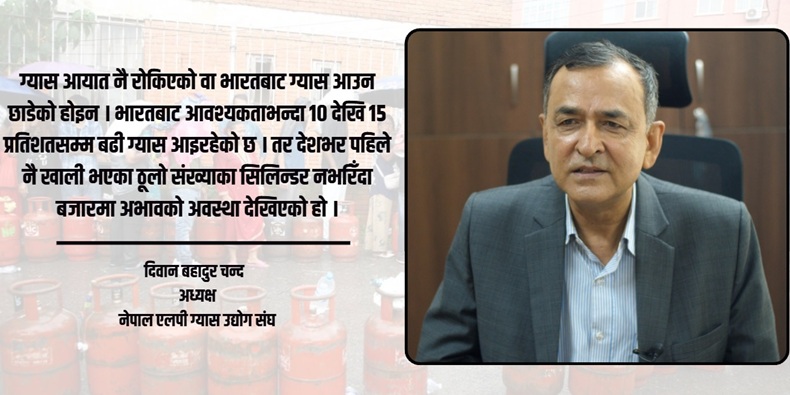
According to Chairman Chand, the current problem is not due to a halt in gas imports or gas stopping coming from India. According to him, 10 to 15 percent more gas than required is coming from India. However, the shortage in the market is due to a large number of cylinders that were already empty across the country not being refilled.
Chand stated that in Kathmandu alone, about 40,000 gas cylinders are consumed daily under normal circumstances. He said that currently, efforts are being made to bring around 50,000 cylinders to Kathmandu daily.
However, he clarified that the market cannot return to normal immediately just by increasing new supplies, because a large number of previously empty cylinders have accumulated in homes.
It won’t be easy until empty cylinders are refilled
According to Chairman Chand, the main challenge now is not just to bring new gas, but to refill the cylinders that were previously empty.
He said, ‘Normally, 40,000 cylinders are consumed. Currently, about 50,000 are coming in. But previously empty cylinders are being held. Until Nepal’s 17.5 million cylinders are refilled, gas will not be readily available in Nepal. That refilling means more gas coming in, by increasing imports.’
According to him, while Nepal previously needed about 50,000 metric tons of gas per month, now up to 60,000 metric tons of gas has arrived. However, he states that even this amount cannot meet the demand.
According to Chand, the main reason for the current chaos is not a gas shortage, but rather a disruption in the supply and distribution system. According to him, after a large number of empty cylinders accumulated in the market all at once, it is taking time to refill them and send them back to the market.
Expensive Transportation System
Gas industries are currently adopting an alternative transportation system to bring gas to the Kathmandu Valley. Since gas bullets coming from India cannot be brought directly to Kathmandu, Chand said that gas is unloaded in Tarai districts, cylinders are filled there, and then brought to Kathmandu by road.
According to him, 10-wheeler trucks are being used to come to Kathmandu. Although they can normally carry up to 21 tons, due to the condition of roads and old bridges, they currently have to carry only 15 tons.
According to Chand, since large 12 or 14-wheeler trucks cannot go on some roads and old bridges cannot withstand heavy loads, there is a compulsion to transport with 10-wheeler trucks. This has increased transportation costs.
He also mentioned another problem: gas industries in Kathmandu do not have large trucks. He stated that due to problems with large trucks entering the city, gas has to be distributed only through smaller vehicles.
Chairman Chand clarified that industrialists do not determine the base price of gas. According to him, the Nepal Oil Corporation has the right to determine gas prices. However, he stated that in the current unusual circumstances, additional transportation costs have been incurred, requiring their management.
‘We have not increased the price of gas, nor do industrialists increase the price of gas. It’s something the Oil Corporation determines. But extra transportation costs were incurred, so that has to be paid somewhere,’ he said.
According to him, industrialists receive only about 32 rupees when they fill and sell one cylinder. He stated that if they have to bear additional transportation costs from that same amount, industrialists will also face problems.
He stated that the distance from Hetauda to Kathmandu is about 131 kilometers, and Nepal Oil Corporation has already adjusted transportation costs for up to 50 kilometers. He said that for the remaining distance, transportation costs have been determined based on relevant decisions.
According to him, based on the Corporation providing 57 rupees 57 paisa for 50 kilometers, the cost for the remaining 81 kilometers, including VAT, reached approximately 105 rupees. ‘We have based this on the law, we have not gone outside the law,’ he said.
Selling at a higher price is ‘black marketeering’
During the gas shortage, consumers in some places are complaining about having to pay more than the stipulated price. Regarding this, Chand stated that the industry association has set a maximum selling price and has instructed all industries and dealers.
According to him, the industry association has decided through a general assembly and has written to industrialists and dealers not to sell gas above the fixed price.
‘Currently, the price of gas in Kathmandu is not more than 2165 rupees. Sales and distribution should be done without exceeding this. This must also be communicated to their dealers. If it’s more than that, it’s black marketeering,’ he said.
Chand stated that if sold above the fixed price, it would be black marketeering. However, he clarified that the industry association does not have the authority to monitor the market, impose fines, or dole out punishments.
According to him, industries have been providing daily details to the Oil Corporation on how much gas was supplied to which dealer. He stated that the dealer’s address, phone number, and VAT number are also provided. Now, based on these details, he believes the concerned authorities should monitor the market.
According to Chand, it was found that some dealers were going to industries in the Tarai themselves to purchase gas and bring it to Kathmandu, so a decision has been made to stop this practice. He stated that the industry association, suspecting such transactions could increase black marketeering in the market, has instructed to cease such arrangements from today.
Advertisement
He stated that although the transportation cost is included in the price of gas sold by industries, smaller traders who find separate trucks to bring gas can arbitrarily add their own freight charges.
Threats of imprisonment instead of facilitation
Chand stated that while industrialists were maintaining LP gas supply in the Kathmandu Valley by taking risks in adverse circumstances, threats of imprisonment came from the government itself. He complained that instead of the state facilitating problem-solving, given the accusations against industrialists in the ministry and parliamentary committees, threats were made.
Chand said, ‘In Monday’s meeting, as soon as he (the minister) met, he said, ‘Gas will only come if you are imprisoned.’ The issue of imprisoning industrialists came up in the ministry in the presence of the secretary. I said—if gas comes by imprisoning us, then imprison us. First, ensure gas supply, we will get imprisoned. What’s wrong with being imprisoned for a few days? But that’s not the way. Instead of saying solve the problem and bring gas by any means, such threats have come.’
Chand stated that industrialists sought assistance from government mechanisms to ease the supply system in the valley, but the government showed helplessness.
‘We told the ministers—we will give you 50,000 to 60,000 cylinders daily in Hetauda and Chitwan, please arrange for transportation from there, bring it yourselves. The price also wouldn’t need to be increased, we would give it at the same rate. But they said that the Food Management and Trading Company has only one truck, and they cannot do anything else. After that, we were forced to go ourselves, make agreements with truck operators, take risks, and pay double fare to bring gas,’ he said.
According to Chairman Chand, the entire network of import, transportation, storage, and delivery to consumers rests on the shoulders of the industrialists.
Chand stated that after the lack of cooperation from the ministry, industrialists approached the Prime Minister’s Secretariat to draw attention to collaboration. He has requested the traffic police and district administration to create an environment for easy movement of gas vehicles on the Tribhuvan Highway even during nighttime for Kathmandu.
Efforts to deliver 50,000 cylinders daily
According to Chairman Chand, gas supply in Kathmandu has been increased in recent days. He stated that while about 44,000 cylinders came to Kathmandu the previous day, approximately 52,000 cylinders are expected today.
He said that efforts are also being made to increase the number of gas transport trucks. He stated that currently about 100 trucks are engaged in gas transportation, and preparations are underway to deploy more trucks.
According to him, the government has been urged to coordinate with truck operators and increase the dispatch of gas-carrying vehicles from Hetauda from once a day to two or three times a day. He also stated that a demand has been made to allow vehicles returning with empty cylinders to operate even at night.
The government’s role should be ‘macro’, not micro.
Chairman Chand suggests that to solve the gas crisis, the government should not only focus on monitoring industries and dealers but also initiate diplomatic efforts for further gas imports from India.
According to him, gas industrialists are bringing gas from India to the best of their capacity. But high-level government initiatives are needed for further imports.
‘It is not appropriate for the minister to go around factories, pick up the phone, and say ‘Come, I will give you gas.’ Instead, the minister should work at a macro level by talking through the ambassador or the first secretary, Ministry of Foreign Affairs, on how to import gas, not at a micro level,’ he said.
According to him, 10-15 percent more gas than required is currently coming from India. However, he states that since there is a large number of already empty cylinders in Nepal, the problem will not be fully resolved until further imports are made.
Industrialists are ready, government initiative is needed
Chand claimed that it is not the case that gas industrialists do not want to bring gas, transporters have refused to transport it, or imports have stopped.
‘We have not said that gas is not being brought at all, that we are not trying to bring it, that transporters are on strike, or that transporters should not bring it,’ he said.
According to him, as much gas as is currently coming in, is being sent to the market. But due to the large number of empty cylinders in homes, there is a need to import more gas according to demand.
He added, ‘Currently, daily consumption in Kathmandu is 40,000 cylinders. Now, even one hundred thousand cylinders would sell. What does it matter to anyone if we supply one hundred thousand cylinders each day for a month? But until the empty cylinders accumulated in our homes are refilled, this will not be easy.’
Claim that the problem will not be solved in one day
According to Chairman Chand, the current inconvenience will gradually decrease. He stated that despite additional transportation problems due to road blockages at Krishnabhir and other reasons, efforts are currently being made to increase supply through alternative routes and the deployment of more trucks.
He expects that if road routes also become easier within a week, the situation will further improve when the incoming gas supply from other routes is combined.
‘This problem didn’t arise all at once, nor will it be solved all at once,’ he said, ‘but it will be minimized, and the inconvenience will decrease.’
According to him, gas is currently coming easily from India. He claims that recently there have been no major disruptions in supply, and 10-15 percent more gas than the required amount is arriving each month.
Behind the gas crisis, the main reasons appear to be not a complete halt to gas imports, industries’ unwillingness to bring it, or a transporters’ strike, but rather a large number of previously empty cylinders, increased cost of alternative transportation, road and transport problems, imbalance in distribution, and the lack of necessary high-level initiatives for additional imports as per demand.
For more: Nepal LPG Crisis Explained